Why EPR Must Be at the Centre of Critical Minerals Recovery: A Policy Perspective
Mongolia Circular Battery Initiative (MCBI) | Policy Commentary | June 2026
The global race to secure critical minerals for the energy transition is accelerating but the policy tools to govern what happens to those minerals after they enter batteries remain dangerously underdeveloped. Extended Producer Responsibility (EPR) offers a proven framework to close this gap. For mineral-rich countries like Mongolia, getting EPR design right is not an abstract regulatory question: it is a strategic economic and environmental priority.
The Global Context: EPR Is Moving Fast
Regulatory momentum around battery EPR has shifted decisively in the past two years.
In the European Union, Regulation (EU) 2023/1542 the EU Batteries Regulation entered into force in August 2023 and extended its reach significantly in August 2025, when key EPR and labelling obligations became enforceable across all member states. These requirements cover the full battery lifecycle: collection targets, recycling efficiency rates, producer registration obligations, and take-back schemes. Supply chain due diligence rules covering critical raw materials including cobalt, natural graphite, lithium, and nickel — also form a central pillar of the regulation, though implementation has been phased.
In the United States, the EPA and the Department of Energy have been developing a voluntary EPR framework for all battery types, as mandated by the Infrastructure Investment and Jobs Act. A series of focused stakeholder conversations took place throughout 2025 and into early 2026, addressing recycling goals, cost structures, product design, and collection models. Simultaneously, multiple US states including Vermont, Illinois, Colorado, Oregon, and Washington enacted new battery EPR laws taking effect in 2026.
The direction of travel is clear: EPR is becoming the standard instrument through which governments hold producers accountable for battery end-of-life outcomes.
What EPR Actually Does — and Why It Matters for Critical Minerals
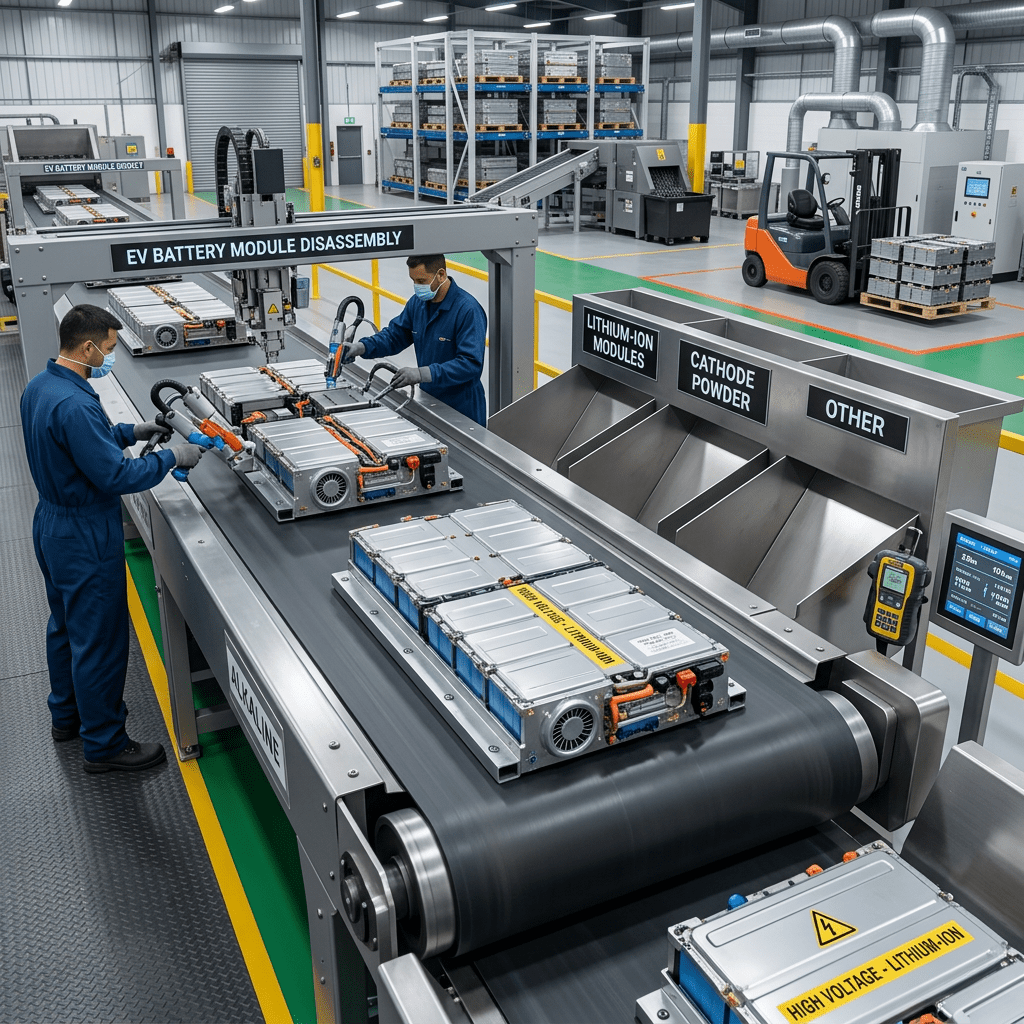
Extended Producer Responsibility shifts the financial and operational burden of waste management from governments and taxpayers to the companies that place products on the market. For batteries, this means manufacturers and importers are responsible for ensuring that spent batteries are collected, sorted, and processed rather than landfilled or informally recycled.
This matters for critical minerals recovery in three concrete ways:
1. It creates economic incentives for design-for-recycling. When producers bear the cost of end-of-life management, they have a direct financial reason to design batteries that are easier to disassemble and from which valuable minerals lithium, nickel, cobalt, manganese, graphite can be efficiently recovered. Without EPR, these costs are externalised to municipalities and informal waste systems.
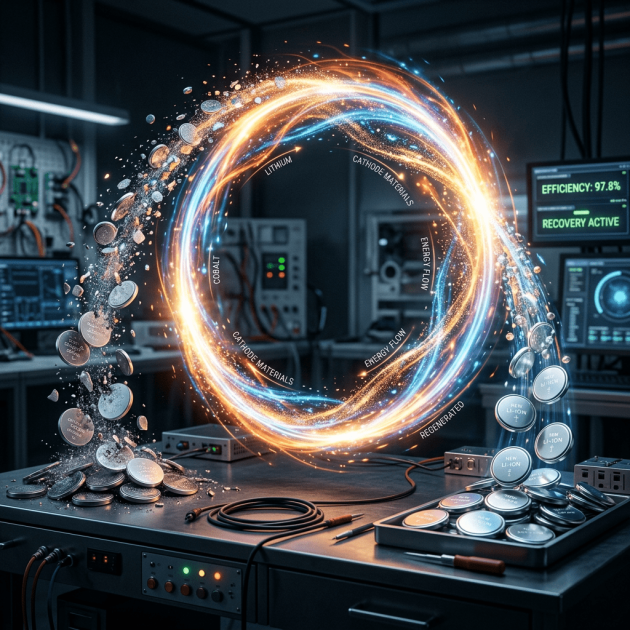
2. It generates a domestic secondary supply of critical minerals. Recycled batteries are a growing source of critical minerals. The International Energy Agency estimates that by 2040, recycled battery materials could reduce demand for new primary mining of key minerals by approximately 10%. Domestic recycling infrastructure funded and organised through EPR mechanisms means that minerals recovered from spent batteries can re-enter local supply chains rather than being lost to waste streams or shipped abroad.
3. It builds the institutional infrastructure that mineral-rich countries need. For countries that are both mineral exporters and emerging battery importers Mongolia is a clear example EPR frameworks provide the governance architecture to track, collect, and process battery waste systematically. Without this infrastructure, the long-term value of critical mineral resources is captured elsewhere in the supply chain.
Mongolia’s Position: A Policy Opportunity Not Yet Seized
Mongolia sits at a distinctive junction. It holds significant deposits of minerals critical to battery production lithium, copper, fluorspar, and rare earths while simultaneously experiencing rapid growth in EV and electronic device adoption. The country’s existing legal framework, anchored by the 2017 Waste Law, does not yet include specific provisions for lithium-ion or EV battery waste. There is no mandatory producer registration, no collection target, and no dedicated recycling infrastructure governed by EPR principles.
This regulatory gap creates real risks. Batteries discarded through informal channels contaminate soil and groundwater with heavy metals and electrolyte compounds. The minerals embedded in spent batteries minerals that Mongolia in some cases exported as raw materials are lost to landfill rather than recovered for re-use. And as EV adoption scales, the volume of end-of-life batteries entering the waste stream will grow significantly over the coming decade.
The opportunity, however, is equally significant. Mongolia has the chance to design an EPR framework from the ground up learning from both the achievements and the implementation challenges observed in the EU and US contexts, and adapting those lessons to Mongolian institutional realities.
MCBI’s Approach: Building Toward an EPR-Compatible System
The Mongolia Circular Battery Initiative is working to demonstrate, at pilot scale, what a collection and recovery system for spent batteries can look like in the Mongolian context before comprehensive legislation exists.
This matters because EPR frameworks do not emerge from legislation alone. They require working logistics (collection points, transport, sorting), technical capacity (analysis of battery chemistries, processing capability), and stakeholder trust (between producers, retailers, municipalities, and recyclers). MCBI’s Czech-Mongolia cooperation model is specifically designed to transfer knowledge and operational experience from the EU’s established battery circular economy into the Mongolian context, building the foundations that a future EPR regime will need.
In parallel, MCBI is engaging with Mongolia’s Ministry of Environment and Climate Change on the policy architecture required to bridge the current regulatory gap including the case for an inter-ministerial working group that can coordinate across the Ministries of Mineral Resources, Finance, Industry, and Digital Development, all of which have a stake in how battery waste governance develops.
Key Policy Recommendations
For policymakers in Mongolia and comparable mineral-rich economies at early stages of battery EPR design, MCBI identifies the following priorities:
- Establish producer registration as the first legal step. Before collection targets can be enforced, there must be a clear and binding definition of who is responsible including importers, not only domestic manufacturers.
- Design collection infrastructure for low-density contexts. EPR collection models developed for dense urban environments in the EU or US require adaptation. Mongolia’s geography demands a different approach: decentralised drop-off points, reverse logistics partnerships, and mobile collection complementing fixed infrastructure.
- Integrate mineral recovery from the start. EPR frameworks that treat spent batteries purely as waste miss the economic opportunity. Recovery targets should be expressed in terms of mineral yield not just battery weight to align incentives with critical minerals strategy.
- Coordinate across ministries. Battery waste governance touches environmental regulation, mining law, trade policy, and industrial development. Single-ministry approaches will produce incomplete frameworks. An inter-ministerial coordination mechanism is essential.
- Build bilateral and multilateral data partnerships. Mongolia’s emerging EPR framework will benefit from data sharing with countries that have run comparable systems. The EU-Mongolia relationship including MCBI’s Czech partnership is a practical channel for this exchange.
Conclusion
EPR for battery waste is no longer a future policy option it is an actively maturing regulatory reality in major markets. For Mongolia, the question is not whether to develop an EPR framework for critical minerals recovery, but how to design one that reflects Mongolia’s specific geography, institutional capacity, and strategic mineral interests.
MCBI is committed to contributing to that design: through pilot demonstration, policy engagement, and knowledge partnership with the EU circular economy community.
The Mongolia Circular Battery Initiative (MCBI) is a circular economy initiative focused on battery recycling, critical minerals recovery, and sustainable resource governance, operating across the Czech Republic and Mongolia. Learn more at mcbis.org.
Tags: EPR | Extended Producer Responsibility | Critical Minerals | Battery Recycling | Mongolia | Circular Economy | EU Batteries Regulation | Policy